top of page


Watergate Scandal: The Downfall of Nixon
On August 9, 1974, the President of the United States resigned from office for the first and only time in American history. That president was Richard Nixon. His downfall was not caused by losing an election or a foreign war, but by a political scandal that exposed corruption, abuse of power, and an attempt to cover up the truth. The Watergate scandal reshaped American politics, transformed investigative journalism, and permanently changed the relationship between the public
Jul 84 min read


Why Does the UK Keep Losing Prime Ministers?
In just over eight years, the United Kingdom has gone through an extraordinary number of prime ministers. Some occupied Number 10 Downing Street for years. Others barely lasted long enough to unpack their belongings. This raises an obvious question: why does the UK keep losing prime ministers? The answer lies in Britain's political system itself — a system designed to remove leaders quickly when they lose support. Britain Doesn't Actually Elect Prime Ministers One of the bigg
Jun 264 min read


From Rebels to Regimes: How do the enemies become the state?
It may sound improbable, but history shows that it has happened multiple times. Across different continents and eras, armed movements have transformed from insurgent groups into legitimate political authorities. Some achieved power through military victory, others through negotiation and political participation. In each case, their transition forces us to confront an uncomfortable reality: the distinction between "terrorist," "rebel," and "government" is often far more compli
Jun 194 min read


Thomas Sankara: The Revolutionary Who Tried to Reinvent a Nation
Imagine a president who sold off the government's fleet of luxury Mercedes and replaced them with the cheapest cars available. A leader who banned officials from flying first class. A revolutionary who argued that freedom could not be imported from foreign powers. This was Thomas Sankara, the charismatic leader often called "Africa's Che Guevara." For just four years, he attempted something extraordinary: to transform one of the world's poorest countries into a self-reliant,
Jun 194 min read


Iran, 1979: The Fall of the Shah
Few events have reshaped a nation as dramatically as the Iranian Revolution of 1979. It was a moment when millions of people from vastly different backgrounds—religious clerics, university students, factory workers, liberals, nationalists, and leftists—came together with a common goal: ending the rule of Iran's monarch. For decades, Iran had been governed by Mohammad Reza Shah Pahlavi, whose ambitious modernization programs transformed many aspects of Iranian society. Backed
Jun 192 min read


Was Socrates right about democracy?
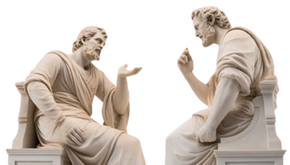
There’s something unsettling about how relevant Socrates still feels today. Over two thousand years ago, in the birthplace of democracy, Athens, he looked at a system people now celebrate as the gold standard of governance and saw a dangerous flaw at its core. Socrates’ critique of democracy wasn’t rooted in elitism for its own sake. It came from a simple, almost uncomfortable analogy: you wouldn’t let random passengers vote on how to steer a ship. You’d trust a trained capta
May 42 min read
bottom of page